Dec 12, 2005

Villakku Thoon

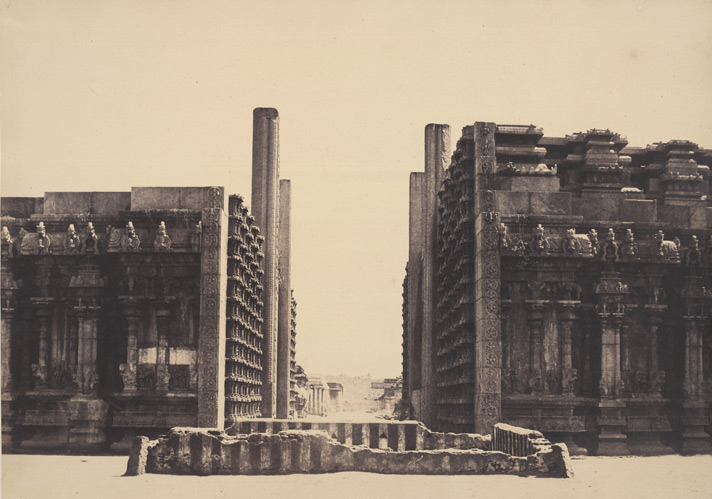
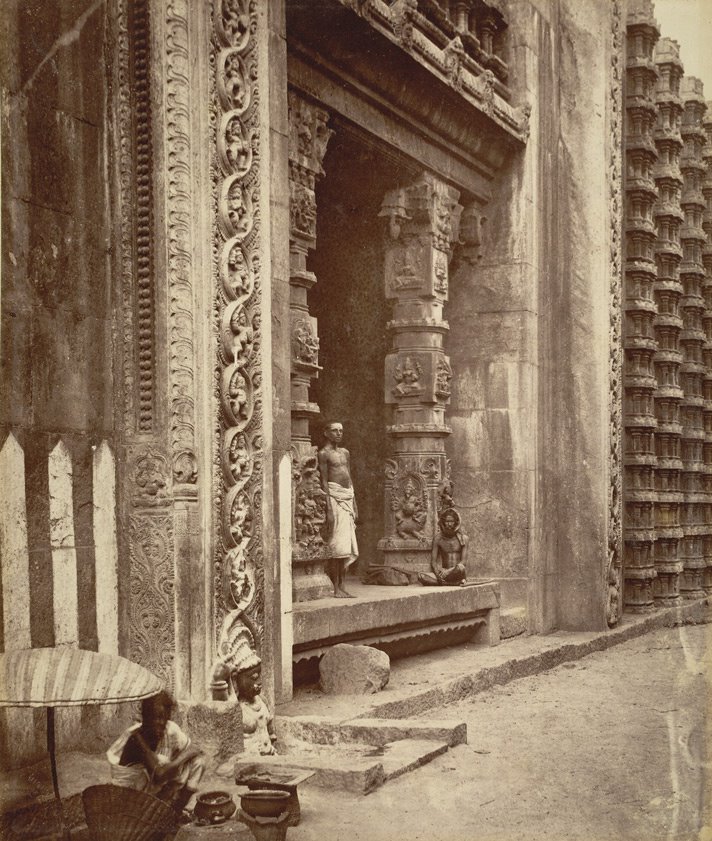
'Photographic Views in Madurai 'by Linnaeus Tripe in 1858.

Every Madurai-vaasi wud have roamed around "Vilakku Thoon" area.But most may not know the history behind the name...It comes from the 'Blackburne Column'...an iron column surmounted by a lamp.It was erected in memory of John Blackburne, Collector of Madurai (1835 to 1848).

The Fort Gate Way!


Fort gate now...
update : read more on the fort gate here


'Photographic Views in Madurai 1858.


This Photograph taken by Linnaeous Tripe in 1858 was once used as the Civil Hospital of Madurai .This building actually is the only remains of the old fort of Madurai....actually one of its gateways. The fort consisted of a double wall with moat and was nearly 4000 yards in circumference.This building in dilapidated state can still be seen opposite the Periar Bus stand.I wonder what its being used as now!


From the 1950s

Yanai Malai


Now...The Yana malai (2005)

Then ... Elephant Rock from 'Photographic Views in Madurai ' by Linnaeus Tripe (1858)
Madurai falls inbetween three hillocks named after the shape of the animal they look like- The Pasu (Cow) malai, the Naga (Snake) malai and the Yanai (Elephant) malai.

The Yanai Malai (Elephant Rock) as imaginatively named by someone, is a rocky hillock -a bold landmark that will catch the eye of anyone entering Madurai from Melur(Chennai highway). As a small kid, from the distant view i got from my terrace, i used to wonder whether it was really an elephant!

distant view across the SundramPark Lake...
 A High-school trecking expedition (1989) took me on top of it. We literally walked along the spine of the elephant to reach its head! I was surprised to see historic rock carvings made by Jain monks (samanars) on the top. Hope this rocky wonder does'nt end up as a granite quarry in the future!
With my school friends on top of the hill ( iam the one with the hat)


One of my favorite pics courtesy Thoonganagar ninaivugal


The Madurai Pavilion


A rare Picture from Thomas & William Daniell's 'Oriental Scenery'1797. c.British Library


This stone pavilion was built by Tirumala Nayakar on the east side of the Madurai Fort and was used during religious festivals. This view particularly attracted Europeans as the motif of the pavilion was later reproduced on Staffordshire-ware and on French wallpapers.


This artwork is a hand-colored lithograph titled "Edifizio in Madura" (Building in Madura), published around 1835–1840 in Meissen, Germany, as part of Friedrich Wilhelm Goedsche’s Vollständige Völkergallerie in getreuen Abbildungen (Complete Gallery of Peoples)

The Raja Gopuram


The unfinished saga,1858
Raja Gopuram from the west of the Meenakshi temple taken by Linnaeus Tripe,1858.The tank seen in front is said to have channels connected to the Vaigai river and the vandiur teppakulam.


Closeup of Raja Gopuram taken by Nicholas and Company in the 1870s


One of the landmarks of Madurai - the Raja Gopuram, that stands unfinished in the Madurai Temple complex. Looking from the size of its base and the intricacy of stone work, iam sure that it was planned to be the grandest and tallest of the towers. Every time i cross it, i get curious to know why it was left as an unfinished saga. Did the ruler (Thirumalai Nayakar) pass away before it could be completed? Did the ruler run out of funds !? One popular theory is that, the architects of the time began to feel doubtful about the quality & load bearing capacity of the stones used for the base and were forced to abandon further work. But iam not satisfied with this theory. Architects and master masons who had built so many stone wonders as a family tradition for centuries, choosing faulty stones and using them upto about 12 mts and then having doubts about it-Seems illogical!But who knows? Iam still waiting for a convincing explaination....


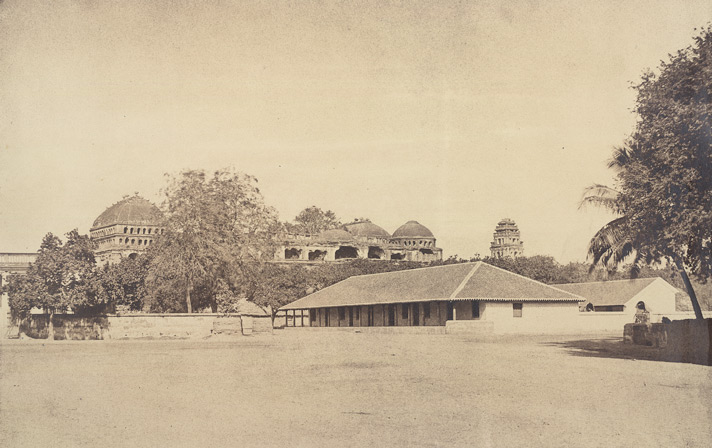
The School at Madurai (1858)


This very neat building in the foreground of the Thirumali Nayakar Mahal was built by G.P. Fischer Esquire, for the accommodation of a School for locals (1858). If you are from Madurai, your great grandfather might have studied here...Wonder what it is now? Have to check out the next time i go home...

p. British library

British Courthouse, Madurai


Photograph of the British courthouse at the Tirumalai Nayakar Palace , taken by a photographer of the Archaeological Survey of India (1899)

c. British Library

Dec 10, 2005

The Golden Lotus Pond..Then & Now !


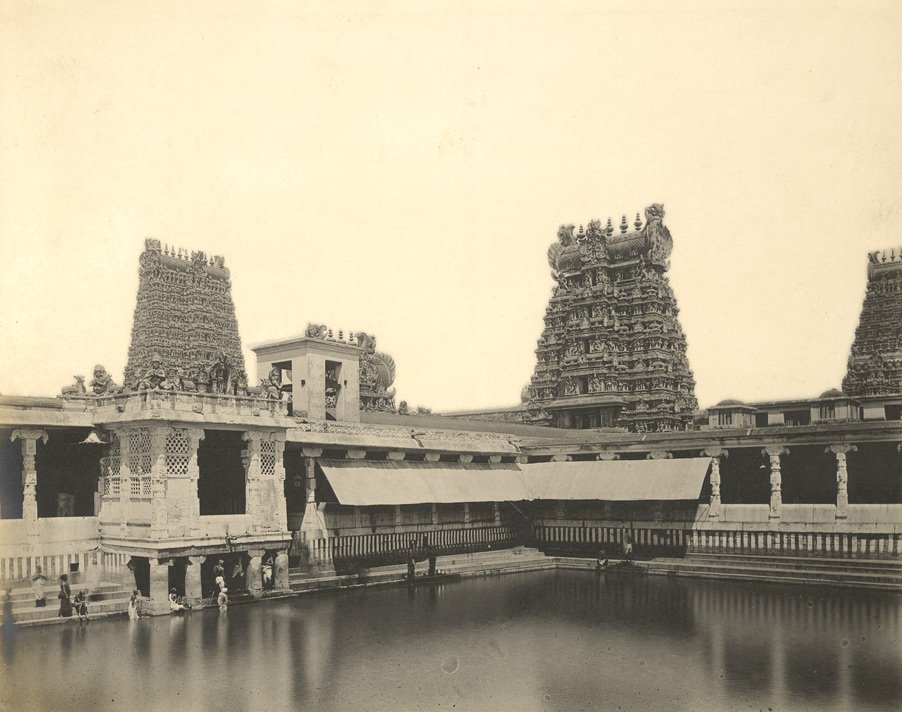
Looking westwards,the temple pond taken by Linnaeus Tripe in 1858 Pond from the north-west, taken by a photographer of the Archaeological Survey of India in 1899


The Pond today (2005). This Pond literally is the Center of Madurai.The 40 m x 60 m is surrounded by stone steps enabling devotees to bathe.


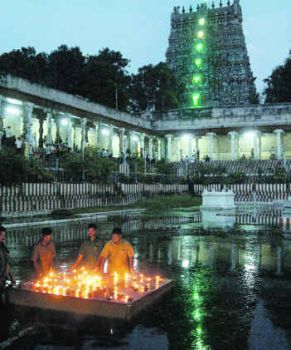
The impressive tower of Meenakshi Sundareswarar temple lends charm to the oil lamps that were lit in the Golden Lotus Pond in connection with Karthigai Deepam (2005)


Legend of The Potramaraikulam...
The history of this pond is as old as Madurai itself.When Kumari Kandam sank into the Indian ocean by repeated deluges, the TenMadurai of the Mudhal Sangam age and Kabadapuram of Idai sangam age submerged into the ocean depths. Later down history, the Pandyan Kings were on the look out for a place to build a new capital that will recapture the legendary glory of the sunken Madurai of their forefathers. According to legend , some merchants passing through a forest known as Kadambavanam saw a beautiful lotus pond and a wooden temple on its bank.They were so fascinated by this location that they reported about it to their king Kulasekara Pandian on return. Soon a 'lotus shaped' city was planned with the pond and temple as its center.
The lotus tank evolved into an important city center in the height of the last Pandian era. The area around this pond was the meeting place of the Kadai Sangam - the last of the ancient academy of poets.

The pond is now a source of too many myths or rather jokes…One is about the Tamil sangam… The story goes that the academy judged the worth of any work of literature presented before it by throwing it into this pond. Only those that did not sink were considered worthy of attention. Another joke i heard is that , the pond is the drop of nectare that fell form Shiva's hair and hence the city was named madurapuri (drop of nectare)! Iam pained to see that reputable and learned people of the city saying stuff like this and making a mockery of our great Sangam culture and our basic common sence!

1910 Unknown photographer

1897-1904 by V. M. Doroshevich


The South and North Towers , Then and now...

Then...South gopuram of the Minakshi Sundareshvara Temple , Madurai, taken by Wiele and Klein in the 1890s


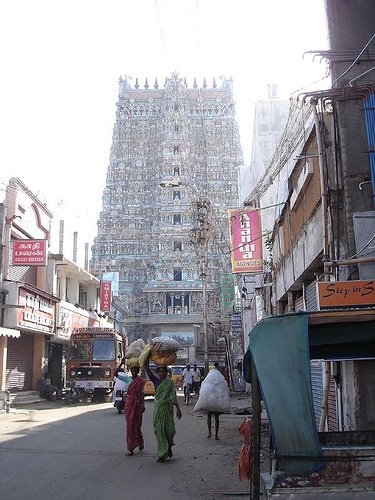
Now... South tower (2005)
South tower 1865 photographer unknown 
North tower 1865 photographer unknown 

South tower by Studio Bourne & Shepherd 

The West & East Towers, Then and now...


Then... West gate of the Minakshi Sundareshvara Temple, Madurai(1870)


Now...west gate, can u see anything changed?(2003)


East tower - 1900 -10


East tower 1870s by Nicholas & company


East entrance 1870


East tower by Nicholas & co 1878


East gopuram by capt. Linnaeus Tripe, 1858